Currently ranked #11 Amazon Best Sellers Rank

Currently ranked #11 Amazon Best Sellers Rank ( #11 in Kindle Store > Kindle Short Reads > 45 minutes (22-32 pages) > Politics & Social Sciences )

Thank you friends and family! Much love!

Check out my latest book on Kindle or the Kindle App! $2.99

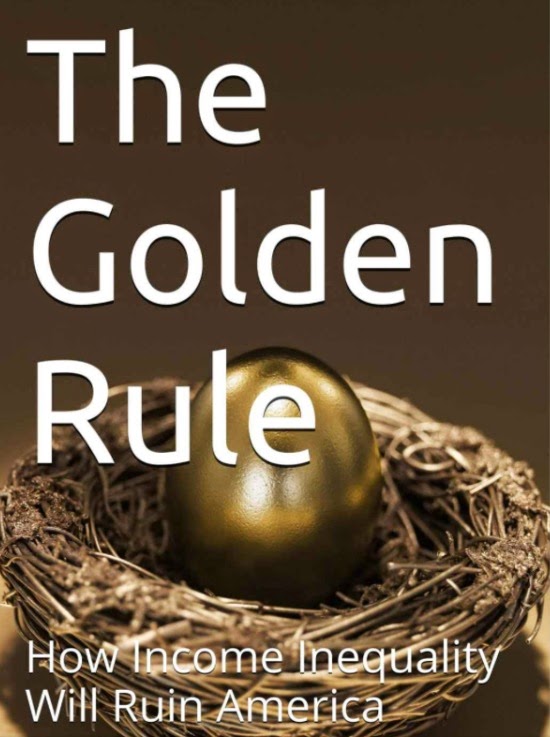
“The Golden Rule: How Income Inequality Will Ruin America”

http://lnkd.in/bs5GX2h

http://renweichung.weebly.com/

"The Golden Rule: How Income Inequality Will Ruin America"

Check out my latest book on Kindle or Kindle App! $2.99

“The Golden Rule: How Income Inequality Will Ruin America”

http://www.amazon.com/dp/B00JOLCZSG

The rule of law in the United States is compromised when it has a disparate impact on low socioeconomic classes, promotes a supposed universal “war on drugs,” but administers drug sentences unevenly; requires mandatory minimum sentencing for blue-collar crime, but negotiates monetary settlements for white-collar crime; sentences black men to nearly 20% longer terms than white men for similar crimes; prevents immigrants and indigent citizens from access to justice; and imprisons more of its population than any other country.

For 40 years, Mr. Greenspan believed the financial markets could self-regulate. He has since admitted a flaw in his philosophy and no longer believes this ideology to be accurate. Many citizens of the United States have yet to realize the flaw in their model, which they perceive as the critical functioning structure of how America works. America has been built upon the premise that it is a land of equal opportunity. However, study after study is revealing statistics that directly counter this belief.

The economic influence of inequality negatively impacts how the rule of law is administered in the United States.

Economic inequality begets legal inequality.

America’s administration of the rule of law is not meant and should not be used to advance the cause of inequality.

Unfortunately, America’s income inequality is rising. There is a high correlation between income inequality and legal inequality in America. As citizens, we should seek to reduce this correlation coefficient because of the disturbing ramifications for the rule of law.
Life Lessons From Marina Keegan’s Posthumous Book of Essays

 By  | Healthy Living – 20 hours ago

The new book, out now. Photo: ScribnerWith this week’s publication of “The Opposite of Loneliness,” Marina Keegan’s posthumous collection of essays and stories, comes a gift no one ever fully wants to receive — bright and youthful wisdom from a talent who died too soon. Keegan was just 22 years old and five days past graduating magna cum laude from Yale University when she was killed in a car accidenton her way to meet her family for her father’s birthday party on Cape Cod. And while she had a brilliant future ahead of her — a job lined up at the New Yorker, a play about to be produced at a theater festival — the rising star had already made a major mark.

More on Yahoo Shine: Forever Young: 7 Celebrities Who Died Tragically Early

“When a young person dies, much of the tragedy lies in her promise: what she would have done,” notes Anne Fadiman, a professor and Keegan’s mentor at Yale, in the new book’s introduction. “But Marina left what she had already done: an entire body of writing far more than could fit between these covers.”

More on Yahoo: Marina Keegan’s Words Live On, One Year After Her Death

Shortly after Keegan’s death, her final essay for the Yale Daily News went viral, receiving more than 1.4 million hits. That piece, “The Opposite of Loneliness,” is the first in the new collection — one that you’ll be grateful is here, in spite of yourself. Here are just five of many lessons the young writer’s words teach:

1. Don’t be afraid to recalibrate your goals.
In her introduction, Fadiman recounts a story told to her by Keegan’s parents, about a sailing competition Keegan had entered when she was 14. Though she was a junior sailor, Keegan believed she could beat everyone, no matter how much more experienced they were. But the day was stormy, with 40-knot winds and 3-foot waves that caused her boat to capsize repeatedly. “Marina’s original goal had been to win,” Fadiman writes. “Her new goal was to finish. She came in second to last, to incredulous applause. She was soaking wet, her hair was bedraggled, and her hands were bloody from gripping the lines.”

2. You’re not alone in thinking you’re unworthy. Just keep it in perspective.
“I’m so jealous. Unthinkable jealousies, jealousies of the Pulitzer Prize-winning novel I’m reading and the Oscar-winning movie I just saw. Why didn’t I think to rewrite ‘Mrs. Dalloway’? I should have thought to chronicle a schizophrenic ballerina. It’s inexcusable. Everyone else is so successful, and I hate them.” But, she adds, “someday the sun is going to die and everything on Earth will freeze. This will happen. I used to think that printing things made them permanent, but that seems so silly now.”

3. You don’t have to pursue goals that you despise.
“What bothers me is this idea of validation, of rationalization. The notion that some of us (regardless of what we tell ourselves) are doing this because we’re not sure what else to do,” she writes in an essay about how 25 percent of Yale grads would enter the consulting or finance industry. “That’s super depressing! I don’t understand why no one is talking about it. I feel like we can do something really cool to this world. And I fear — at twenty-three, twenty-four, twenty-five — we might forget.”

4. Value life — all of it.
“People are strange about animals. Especially large ones,” she writes in one essay. “Daily, on the docks of Wellfleet Harbor, thousands of fish are scaled, gutted, and seasoned with thyme and lemon. No one strokes their sides with water. No one cries when their jaws slip open. I worry sometimes that humans are afraid of helping humans. There’s less risk associated with animals, less fear of failure, fear of getting too involved.”

5. It’s never too late (even if you’re not in your 20s).
“What we have to remember is that we can still do anything. We can change our minds,” she writes in the book’s titular essay. “We can start over. Get a post-bac or try writing for the first time. The notion that it’s too late to do anything is comical. It’s hilarious. We’re graduating from college. We’re so young. We can’t, we MUST not lose this sense of possibility because in the end, it’s all we have.”